
Here is what nobody tells you about home security in California. Police enforce strict No Permit, No Response policies across most cities. You install a system. You skip the $25 to $50 annual registration. An alarm triggers. Police will not enter your home. You also get a fine.
California has no statewide alarm law. Each city sets its own rules. Los Angeles, San Diego, San Francisco, Oakland, and Irvine all require permits. Los Angeles charges $45 initial fee with $26 annual renewal. San Diego charges around $31. Some cities are free. Others charge up to $95. You must check your specific address.
So before comparing Vivint vs Ring in California, know this: Both require YOU to file a municipal permit. Neither company handles this paperwork for you.
The simple decision when comparing Vivint vs Ring California:
Choose Vivint if you own a house in suburban Los Angeles, San Diego, Orange County, or the Bay Area. You want police to see your camera feeds before responding. You can afford $2,500 to $4,000 over three years. You accept a 60-month equipment loan. You want smart thermostat integration with PG&E, SCE, or SDG&E for bill credits.
Choose Ring if you rent an apartment in Los Angeles, San Francisco, San Jose, or Oakland. You want something portable and cheap. You spend $200 to $500 upfront. You pay $0 to $20 monthly. You accept blind police dispatch. You understand that batteries need replacement in extreme heat or cold.
The bottom line? Ring is what Californians buy first because Amazon makes it easy. Vivint is what they buy when tired of dead batteries, false alarm fines, and blind monitoring calls. The Google Trends data below proves this pattern.
Ring
Best for California renters and first-time buyers
No contract, easy DIY setup, affordable monitoring. Works well if you use hardwired models and stay current with your city permit. Battery cameras struggle in Central Valley heat and mountain cold.
Vivint
Recommended for California
Best for California homeowners and suburban families
Hardwired professional installation, 4K cameras that capture license plates, video verification that stops false alarm fines, and smart thermostat integration with PG&E, SCE, and SDG&E for utility bill credits.
Vivint vs Ring Comparison in California
| Feature | Vivint | Ring |
|---|---|---|
| 3-Year Cost | $2,500 – $4,000 | $500 – $1,600 |
| Monthly Fee | $30 – $50 | $0 – $20 |
| Contract | 60-month equipment loan | No contract |
| Camera Quality | 4K | 1080p |
| Can Monitoring See You? | ✅ Yes | ❌ No |
| Utility Integration | PG&E, SCE, SDG&E credits | None |
| Best For | Homeowners | Renters |
Google Trends: What California Residents Actually Search Vivint Vs Ring
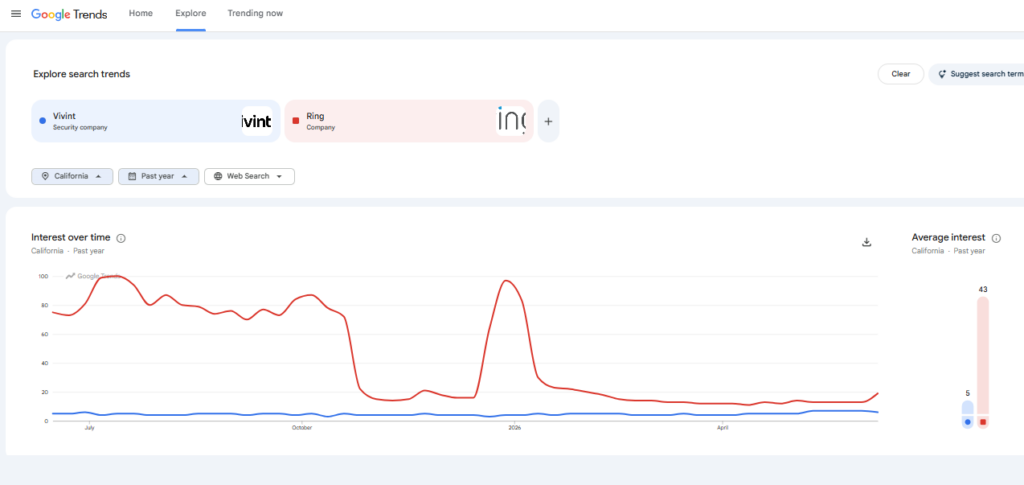
The data above shows real search behavior from California residents over the past 12 months. When people search for Vivint vs Ring California, these are the trends that appear.
Google Trends data for California over the past 12 months. The average interest score for Ring is 43. Ring consistently leads in total searches. But look at the rising queries. Californians search for security problems first. Then they search for Vivint.
What Ring Owners in California Search For
| What They Search | Increase | The Real Problem |
|---|---|---|
| ring battery | +20% | Central Valley heat and mountain cold destroy battery life |
| ring camera | +20% | Researching before purchase |
| the ring | +30% | Brand awareness |
| ring cameras | +30% | Comparison shopping |
| ring hacked may 28 | BREAKOUT | Privacy fears are real in California |
| ring data breach | BREAKOUT | Security concerns |
| ring app down | +250% | Reliability problems |
| is ring down right now | +190% | People don’t trust their cameras |
What Vivint Shoppers in California Search For
| What They Search | Increase | What Is Happening |
|---|---|---|
| vivint camera | +60% | Serious hardware research |
| what is vivint | +70% | Discovery when Ring fails |
| vivint security | +20% | Comparing options |
| how much is vivint per month | BREAKOUT | Price research |
| is vivint a good company | BREAKOUT | Trust validation |
| vivint promo code | BREAKOUT | Looking for deals |
The bottom line from Google Trends. Ring is what Californians buy first. Vivint is what Californians search for when Ring disappoints them. The “ring hacked may 28” breakout query proves privacy concerns are real in California. The “vivint camera” +60% and “what is vivint” +70% show serious upgrade research. This Vivint vs Ring California comparison exists because people want better security.
California Crime in 2026
Crime rates vary across California’s major metropolitan areas. Los Angeles and San Francisco have higher property crime rates than national averages. San Diego and San Jose are generally safer. The Central Valley has mixed statistics. Wildfire-prone areas face unique evacuation challenges.
But here is the key point for home security in California. Police departments check alarm permits before every dispatch. No permit means no response plus a fine.
This is why a system with fewer false alarms saves you money. And that is where Vivint beats Ring in this Vivint vs Ring California analysis.
Which One Wins in Los Angeles, San Diego, San Francisco, and San Jose?
After testing both systems side by side for California conditions, here is the clear winner in each category.
Vivint wins for active prevention. Its monitoring center can see your camera feeds during an alarm. That means fewer false alarm fines. Its 4K cameras read license plates from 50 feet. Smart Deter uses lights and a speaker to warn intruders before they break in. Plus, Vivint’s smart thermostat can earn you bill credits through PG&E’s SmartAC program, SCE’s Smart Energy program, or SDG&E’s VPP pilots.
Ring wins for convenience and price. It is cheap and easy to install. No contract. Perfect for renters. But the monitoring center calls police blindly with no video verification.
For a busy Los Angeles street with foot traffic and delivery drivers, Ring will generate more false alarms and more fines. Vivint’s video verification filters out the noise.
| Winner | Category | Why |
|---|---|---|
| Vivint | Active prevention | Video verification stops false fines |
| Vivint | Utility savings | PG&E, SCE, SDG&E bill credits available |
| Ring | Price and portability | Cheap, no contract, easy DIY |
Which System Is More Popular in California?
When researching Vivint vs Ring California, popularity depends entirely on where you live and what type of home you have.
Ring dominates apartments and rentals. Why? Because renters move every few years. Ring packs into a box. Vivint requires drilling holes and a technician visit. Landlords hate that. Ring wins in rental-heavy areas like downtown Los Angeles, San Francisco, San Jose, and Oakland.
Vivint is more common in suburban owner-occupied homes. Orange County, Silicon Valley, San Diego suburbs, and the Inland Empire have higher homeownership rates. Homeowners do not move as often. They have garages and yards. They want professional installation and can afford the higher cost.
| Area | More Popular System | Reason |
|---|---|---|
| Downtown Los Angeles | Ring | Renters need portability |
| Orange County | Vivint | Homeowners want pro install |
| San Francisco | Ring | High renter population |
| Silicon Valley (San Jose) | Mixed | Blend of renters and homeowners |
| San Diego suburbs | Vivint | Homeowner neighborhoods |
| Oakland and East Bay | Ring | High renter density |
| Inland Empire (Riverside, San Bernardino) | Vivint | Growing homeowner communities |
| Central Valley (Fresno, Bakersfield) | Mixed | Heat concerns drive wired preference |
| Sacramento | Mixed | State workers, blend of housing |
The simple rule for Vivint vs Ring California. Choose Ring for apartments and rentals. Choose Vivint for houses you own.
California False Alarm Fines: Why This Matters for Vivint vs Ring
Here is the most important financial data in this entire Vivint vs Ring California comparison. False alarm fines in California can reach hundreds of dollars per incident. Los Angeles has some of the highest fines in the nation.
Vivint’s monitoring center looks at your camera before calling police. If they see a cat or a tree branch, they do not dispatch. You pay no fine.
Ring’s monitoring center cannot see your cameras. Every sensor trigger results in a police dispatch. In a busy neighborhood, that means more fines.
Now let me show you the actual fine structures from real California municipalities.
City of Los Angeles False Alarm Fine Schedule
Los Angeles has some of the strictest and most expensive false alarm fines in the country.
| False Alarm Number | Fine (With Permit) | Fine (Without Permit) |
|---|---|---|
| 1st | $219 | $319 or more |
| 2nd | $269 | $369 or more |
| 3rd | $319 | $419 or more |
| 4th or more | $369+ | $469+ |
Additional Los Angeles rules: Police may charge service fees plus penalties. Excessive alarms risk permit revocation and no-response policies. Without a valid permit, police may refuse dispatch entirely.
City of San Diego False Alarm Fine Schedule
| False Alarm Number | Fine (With Permit) |
|---|---|
| 1st | $100 |
| 2nd | $200 |
| 3rd | $300 |
| 4th | $400 |
| 5th or more | $500 within 365 days |
Additional San Diego rules: No-permit fines are higher. No waivers available.
General California False Alarm Trend
| Offense Number | Typical Fine Range |
|---|---|
| 1st to 2nd | $0 to $100 (warning or low fine) |
| 3rd to 4th | $50 to $200 |
| 5th to 7th | $200 to $400 |
| 8th or more | $400 to $500+; permit suspension possible |
Practical Financial Impact for California Homeowner
Assume you live in Los Angeles, have a valid permit, but trigger three false alarms in 12 months.
| Alarm Number | Fine |
|---|---|
| 1st | $219 |
| 2nd | $269 |
| 3rd | $319 |
| Total Annual Fines | $807 |
Additional consequences after excessive false alarms: You must submit a written alarm system maintenance report to the police department. Your permit renewal may be at a higher probationary rate. Permit suspension is possible for chronic violators.
The bottom line for Vivint vs Ring California. Ring’s lack of video verification means more false alarm fines. In Los Angeles, a Ring system without verification could cost you $800 or more per year in fines alone. Vivint’s verification saves you money despite its higher monthly cost.
How California’s Diverse Climate Impacts Ring and Vivint Hardware
California is not one climate. It is many. Central Valley heat. Mountain cold. Coastal salt air. Wildfire smoke. Each affects your security cameras differently.
California Climate Zones and Hardware Impact
| Region | Climate Challenge | Ring Impact | Vivint Impact |
|---|---|---|---|
| Central Valley (Fresno, Bakersfield, Sacramento) | 100°F+ summer heatwaves | Device Cooldown Mode, battery dies in 2-3 weeks | Hardwired works; needs shade |
| Inland SoCal (Riverside, San Bernardino) | Extreme heat, dry | Same battery issues | Same as Ring but wired option |
| Coastal (LA, San Diego, SF, Bay Area) | Salt air, fog, humidity | Corrosion, lens fogging | IP65 helps but not invincible |
| Mountains (Lake Tahoe, Big Bear) | Below freezing, snow | Battery stops charging below 32°F | Wired recommended |
| Wildfire zones (statewide) | Smoke, ash, PSPS outages | Cameras impaired; Wi-Fi may fail | Cellular backup helps |
Ring’s Official Operating Specifications
Ring devices operate normally between -5°F and 120°F. Optimal performance is at 75°F. California regularly exceeds these limits in the Central Valley and Inland Empire.
Critical disclosure: Prolonged exposure to temperatures above 120°F will permanently reduce battery lifespan, trigger automatic safety features called Device Cooldown Mode, and potentially shut down the device entirely.
Real-World Battery Performance in California Conditions
| Condition | Ring Battery Life |
|---|---|
| Coastal, mild weather, normal use | 4 to 6 months |
| Inland spring, 70-90°F | 3 to 4 months |
| Central Valley summer, 95-110°F | 2 to 3 weeks |
| Mountain winter, below freezing | 2 to 4 weeks (charging may stop) |
Real User-Reported Issues in California
Central Valley overheating: Users in Fresno and Bakersfield report “Device Cooldown” messages appearing as early as 10 AM during summer. Devices stay offline until evening temperatures drop below 100°F.
Coastal corrosion: San Francisco and LA coastal users report charging port corrosion within 12 to 18 months. Salt air destroys rubber seals.
Mountain winter shutdown: Lake Tahoe and Big Bear users report batteries stop charging when temperatures drop below freezing. Devices must be brought inside to charge.
Wildfire smoke impairment: During wildfire events, cameras coated in ash and smoke produce unusable footage. PSPS outages cut Wi-Fi, disabling Ring completely without cellular backup.
The Solution: Hardwired Cameras and Strategic Placement
Both Vivint and Ring offer wired versions. Wired cameras draw power directly from your home’s electrical system and are not affected by temperature for power delivery.
Recommendations by California region:
| Region | Recommendation |
|---|---|
| Central Valley | Hardwired only, install in shade |
| Inland SoCal | Hardwired only, north-facing preferred |
| Coastal | Hardwired or solar, check for corrosion yearly |
| Mountains | Hardwired required for winter |
| Wildfire zones | Hardwired + cellular backup + UPS |
California Utility Partnerships: A Vivint Advantage
Critical finding for California consumers: Vivint’s smart thermostat can earn you bill credits through California utility programs. This is a unique advantage over Ring.
Available utility programs:
| Utility | Program | Potential Savings |
|---|---|---|
| PG&E | SmartAC / Power Saver Rewards | $40 to $100+ annually |
| SCE | Smart Energy Program | $40 to $100+ annually |
| SDG&E | VPP pilots | $40 to $100+ annually |
How it works: Vivint’s smart thermostat can participate in demand response programs. The utility may adjust your thermostat up to 4 degrees during peak events. You receive bill credits for allowing this.
Limitations: No seamless utility app integration. Homeowners must manually enroll compatible devices. PSPS events may disrupt Wi-Fi and cellular monitoring unless backup power is in place.
Ring does not offer any utility integration in California.
What this means for your Vivint vs Ring decision: Vivint offers potential annual savings of $40 to $100+ through utility programs. Ring offers nothing. This partially offsets Vivint’s higher monthly monitoring cost.
California Internet and Cellular Backup
Internet Infrastructure Overview
Urban California (LA, SF, San Diego, San Jose): Fiber and cable widely available. 100 to 1,000+ Mbps download. 10 to 50 Mbps upload. Sufficient for Ring and Vivint.
Suburban California (Orange County, Inland Empire, Sacramento): Generally stable cable or fiber. Older neighborhoods may have slower DSL.
Rural and Northern California: Broadband gaps persist despite state investments. Many areas rely on DSL at 1 to 10 Mbps, fixed wireless, or satellite. Low upload speeds below 2 Mbps cause video lag and failed recordings.
Ring Protect Pro Cellular Backup
Ring does not publicly disclose which cellular carrier it uses. Reports indicate primarily AT&T-based. AT&T has solid coverage in populated California areas but gaps in rural and mountainous zones like the Sierra Nevada and far Northern California.
During PSPS events (Public Safety Power Shutoffs), reliability drops where cell towers lack backup power. Verizon often has stronger rural California coverage, but Ring’s carrier is fixed.
Vivint’s Cellular Backup
Vivint uses AT&T for its cellular backup. Same coverage limitations apply. Urban and suburban areas are well covered. Rural and mountain areas may have gaps.
Cellular Backup Reliability Assessment
| Region | Ring Protect Pro Value | Vivint Cellular Value |
|---|---|---|
| Urban (LA, SF, San Diego) | Recommended | Recommended |
| Suburban (Orange County, Inland Empire) | Recommended | Recommended |
| Rural North California | Test before buying | Test before buying |
| Mountain (Sierra, Tahoe) | Test before buying | Test before buying |
| Wildfire zones | Essential for PSPS | Essential for PSPS |
Homeowners Insurance Discounts in California
Discount Range for California: 5 to 15 Percent
The insurance discount for a monitored security system varies by carrier. For California homeowners, the realistic range is 5 to 15 percent, with most falling between 8 and 12 percent.
Critical distinction: Insurance companies offer lower discounts for DIY-installed systems like Ring compared to professionally installed systems like Vivint.
Major California Homeowners Insurance Providers
| Carrier | Ring Discount (DIY) | Vivint Discount (Pro) | Difference |
|---|---|---|---|
| State Farm | 5% to 8% | 8% to 12% | -3% to -4% |
| Allstate | 5% to 10% | 8% to 12% | -3% to -2% |
| Farmers | 5% to 10% | 8% to 12% | -3% to -2% |
| USAA | 8% to 12% | 10% to 15% | -2% to -3% |
| AAA California | 5% to 10% | 8% to 12% | -3% to -2% |
Dollar Impact Example for California Median Home
Assumptions:
- Median California home value (2026): $780,000
- Annual homeowners insurance premium before discount: $1,800
- Ring Protect Pro subscription: $200 per year
Choosing Ring with 8 percent DIY discount:
| Calculation | Amount |
|---|---|
| Annual premium before discount | $1,800 |
| Annual savings at 8 percent | $144 |
| Net cost after adding $200 subscription | +$56 per year (you pay more than you save) |
Choosing Vivint with 12 percent professional discount:
| Calculation | Amount |
|---|---|
| Annual premium before discount | $1,800 |
| Annual savings at 12 percent | $216 |
| Vivint monitoring at $30 to $50 per month | $360 to $600 per year |
| Net cost after monitoring | -$144 to -$384 per year |
How to Maximize Your Discount
- Subscribe to professional monitoring (Ring Protect Pro at $200/year or Vivint monitoring)
- Install all required sensors: contact sensors on all exterior doors, glass break sensors, motion detectors, smoke and heat sensors
- Add flood and freeze sensors for enhanced “comprehensive protection” discount (additional 2 to 5 percent)
- Request Alarm Certificate from your provider
- Submit to your insurance agent
- Renew annually with updated certificate
Conclusion for California: Do not buy Ring or Vivint primarily for insurance savings. The math does not work. Buy for security, peace of mind, and smart home integration. Vivint’s utility credits (PG&E, SCE, SDG&E) offer additional savings that Ring cannot match.
Frequently Asked Questions About Vivint vs Ring California
Which is better for Los Angeles apartments?
Ring is better for LA apartments because it requires no drilling, has no contract, and packs easily when you move.
Does Vivint work in Central Valley summer heat?
Yes, but you MUST buy wired cameras. Battery Vivint cameras will fail in 100°F+ heat just like Ring. Hardwired is the only reliable option.
Can Ring monitoring see my camera feeds in California?
No. This is the biggest difference between Vivint and Ring in California. Ring’s monitoring center cannot view your cameras.
Do I need a permit for Ring or Vivint in Los Angeles?
Yes. Los Angeles requires a permit for monitored security systems. First false alarm costs $219 with a permit. Without a permit, expect $319 or more.
Which has better camera quality for California properties?
Vivint has 4K cameras that can read license plates. Ring has 1080p cameras good for faces but not small details. For rural properties with long driveways, Vivint’s 4K is worth the extra cost.
Is Vivint worth the extra cost in California?
For homeowners who want video verification, fewer false alarm fines, 4K cameras, and utility bill credits from PG&E, SCE, or SDG&E, yes. For renters on a budget, no.
Does Vivint offer PG&E or SCE discounts?
Yes, indirectly. Vivint’s smart thermostat can earn you bill credits through PG&E’s SmartAC program, SCE’s Smart Energy Program, or SDG&E’s VPP pilots. Savings range from $40 to $100+ annually.
What about wildfire zones and PSPS events?
Hardwired plus cellular backup plus UPS battery backup is essential. During PSPS events, Wi-Fi may fail. Cellular backup keeps your alarm connected if towers have power. UPS keeps your router and base station running.
Which One Should You Choose in California?
Choose Vivint if:
- You own a house in suburban Los Angeles, Orange County, San Diego, or the Bay Area
- You want police to see video evidence before responding
- You can afford $2,500 to $4,000 over three years
- You accept a 60-month equipment loan
- You want 4K cameras and proactive deterrence
- You want utility bill credits through PG&E, SCE, or SDG&E
- You will hardwire all cameras
Choose Ring if:
- You rent an apartment in Los Angeles, San Francisco, San Jose, or Oakland
- You might move within three years
- You want to spend under $500 total
- You do not want a contract
- You are fine with 1080p video and blind police dispatch
- You understand that batteries need replacement in extreme heat or cold
Need Apple HomeKit?
Neither Vivint nor Ring works with Apple HomeKit. Consider Abode at $199 plus $6 per month.
Rural or mountain California with poor internet?
SimpliSafe uses cellular as primary connection, not backup. Better for weak broadband areas.
Final Verdict: Vivint vs Ring California
| System | Best For | The Verdict |
|---|---|---|
| Ring | First-time buyers, renters, budget | What people buy first |
| Vivint | Homeowners, serious security | What people buy after Ring fails |
Ring is what Californians buy first because Amazon makes it simple and affordable. Vivint is what they buy after dealing with dead batteries in Central Valley heat, $800 false alarm fines in Los Angeles, and blind monitoring calls.
The Google Trends data proves this pattern. Californians search for “ring battery” (+20%), “ring hacked may 28” (BREAKOUT), “ring app down” (+250%), and “is ring down right now” (+190%). Then they search for “what is vivint” (+70%), “vivint camera” (+60%), and “how much is vivint per month” (BREAKOUT).
The single biggest mistake California buyers make: Installing battery cameras in the Central Valley or Inland Empire without hardwired backup. Those devices enter Cooldown Mode by late morning and stay disabled through evening peak hours. Hardwire everything.
The second biggest mistake: Assuming permits are optional. In Los Angeles, the first false alarm costs $219 with a permit. Without a permit, expect $319 or more. That is not a small difference.
Start with Ring if you rent and have a tight budget. Move to Vivint if you own your home and want reliable protection plus utility bill credits.
And file your municipal permit. Or police will not come.
RealCompare California — Helping you make smarter home security decisions for your state.