
Alaska is not just the last frontier — it is also the most challenging state in the United States for home security systems. With winter temperatures that can plunge to -40°F, limited sunlight during the long winter months, and cellular coverage that covers only 4% of the state’s landmass, homeowners face unique obstacles that render many national security solutions ineffective. Whether you live in an Anchorage apartment, a Fairbanks cabin, or a remote property in the Interior, choosing the right security system requires understanding how Alaska’s extreme environment impacts hardware performance.
Vivint Alaska
Professionally installed systems built to handle Alaska’s harsh winters and extreme conditions.
📞 Call Vivint Alaska Today+1 888 784 0392
Ring on Amazon
Affordable DIY smart security you can order online. Easy to set up and flexible for Alaska renters.
🛒 Shop Ring SystemsThe fundamental difference between Vivint and Ring comes down to professional installation versus DIY flexibility, and long-term commitment versus month-to-month freedom. Vivint is the premium, professionally installed solution — a complete smart home ecosystem with 4K cameras, smart locks, thermostats, and a central touchscreen panel, all backed by 24/7 professional monitoring. It is ideal for permanent homeowners who want a set-it-and-forget-it system and are willing to pay a premium for deep integration and professional installation. Ring, on the other hand, is the DIY, Amazon-owned alternative built on affordability and flexibility. You can start with a single video doorbell and expand over time with cameras, sensors, and alarms. With no long-term contracts and month-to-month subscriptions, Ring is the go-to choice for renters, apartment dwellers, and budget-conscious homeowners who value portability and low upfront costs.
Geographically, Ring is more popular in urban rental markets like Anchorage, Fairbanks, and Juneau, where renters cannot make permanent modifications and value the ability to take their system when they move. Vivint is more common in suburban single-family home communities and areas where long-term homeowners invest in permanent, professionally installed systems. Nationally and globally, Ring outsells Vivint by a significant margin — it is the undisputed market leader in DIY security.
2026 Alert: Alaska has no statewide alarm permit law. Valdez has one of the strictest false alarm ordinances in the country, with fines up to $500. In Sitka, you get 4 free false alarms per year, but fines escalate at $50 per occurrence after that.
Vivint Vs Ring Comparison in Alaska
| Factor | Vivint (Professional) | Ring (DIY) |
|---|---|---|
| Long-Term Support | 3-5 year contracts, high cancellation fees. Hard to exit. | Month-to-month. Cancel anytime. |
| Sustainability & Cost | Premium cost, lower volume. High upfront investment. | Affordable, mass-market. Pay as you grow. |
| Security Features | Full integration: locks, lights, thermostat, 4K cams, touchscreen panel. | Modular: mix-and-match cameras, doorbells, sensors. App-controlled. |
| Privacy Worries | Data with Vivint. Poor customer service reputation. | Amazon-owned. FTC fined Ring $5.8M for privacy violations. |
| User Satisfaction | Hardware praised. Service and contracts heavily criticized. | Consistently high marks for ease, value, flexibility. |
| Internet Need | Requires stable Wi-Fi. No cellular backup. | Cameras need Wi-Fi. Alarm Pro has AT&T cellular backup. |
Vivint Vs Ring Google Trends: What Alaska Is Searching
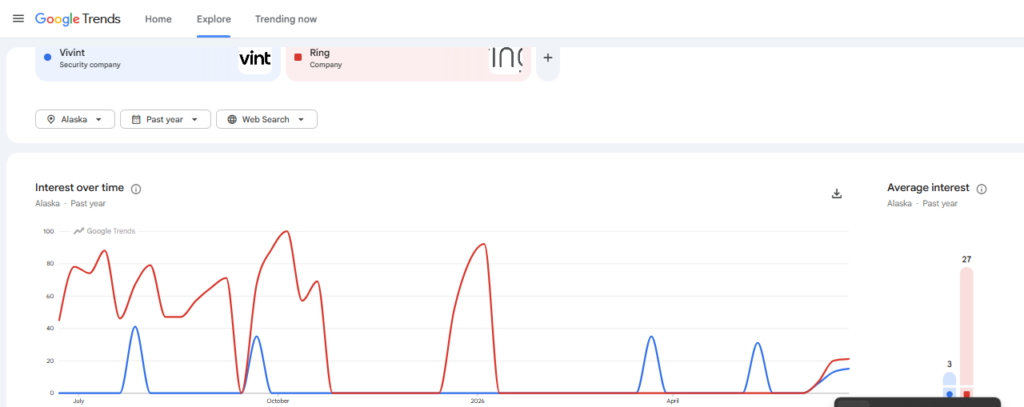
Based on the Google Trends screenshot, Ring dominates search interest in Alaska compared to Vivint. The average interest score is 27, reflecting moderate but meaningful search activity across the state. The data shows that Alaska consumers searching for Ring are highly specific in their queries. “Ring doorbell camera” saw a massive 100% increase in search interest, while “ring camera subscription” jumped 70% and “ring plans” rose 50%. This indicates that Alaska consumers are actively researching both the hardware and the ongoing subscription costs before making a purchase decision. The fact that “ring subscription” and “ring camera subscription” appear as top rising queries suggests that Alaska consumers are particularly price-conscious and want to understand the total cost of ownership. “Ring login” and “ring app” also saw 10% increases, showing that consumers are also interested in the user experience.
For Vivint, the search data tells a different story. “Vivint customer service” saw a 40% increase in search interest, and “vivint” itself jumped 200% in rising queries — though from a very low base. This suggests that Alaska consumers searching for Vivint are either existing customers looking for customer service or potential customers researching the company’s reputation. The fact that “vivint customer service phone number” appears as a breakout query suggests that some Alaska consumers have had negative experiences with Vivint’s support.
| Search Metric | Ring | Vivint |
|---|---|---|
| Average Search Interest | High | Low |
| Top Rising Queries | Ring doorbell camera (+100%), ring camera subscription (+70%), ring plans (+50%) | Vivint customer service (+40%), vivint (+200%) |
| Key Consumer Concern | Product features, subscription costs, app reliability | Customer service quality |
| Search Behavior | Product-specific, research-focused, cost-conscious | Service-focused, reputation-aware |
Warranty vs. Homeowners Insurance: Know Your Coverage
| Factor | Vivint | Ring |
|---|---|---|
| Manufacturer Warranty | 1-2 years, defects only | 1 year, defects only |
| Weather Damage | Not covered | Not covered |
| Extreme Cold / Snow / Ice | File homeowners claim | File homeowners claim |
| Insurance Discount | 5-15% with monitoring cert | 5-15% with Ring Protect Pro |
| How to Claim | Contact Vivint support | Contact Ring support |
In Alaska, homeowners insurance is your primary protection against weather-related equipment damage. Neither Vivint nor Ring covers extreme cold damage, snow accumulation, or ice storms under their standard warranties. The average Alaska homeowners insurance premium is approximately $1,482 per year, and monitored security systems qualify for discounts of 5% to 15% depending on the system features.
Regional Climate Impact: Battery vs. Wired in Alaska
Alaska presents the most extreme environmental stressors for security hardware in the United States. Winter temperatures frequently drop below 0°F (-18°C), with Interior Alaska experiencing temperatures as low as -40°F. Heavy snow accumulation can completely bury outdoor cameras, and the limited winter sunlight makes solar-powered devices unreliable.
Ring devices operate optimally at approximately 77°F (25°C) and can function between -4°F and 122°F (-20°C to 50°C). However, real-world performance in Alaska’s winters tells a different story. At 36°F (3°C), the battery may not hold a charge as effectively, requiring more frequent charging. At 32°F (0°C), the battery may not charge at all — even if hardwired, the external power source cannot recharge it. At temperatures below 0°C, the battery will stop accepting the external charge and may run out of power. At -5°F (-20.5°C), the battery may disconnect power completely until temperatures warm up. Ring officially states that battery-powered devices are run off the batteries, not off of the external power source. When the temperature drops below freezing, the battery will stop accepting the external charge and may run out of power.
| Device Type | Alaska Recommendation | Why |
|---|---|---|
| Ring Battery | Avoid | Won’t charge below 32°F. May stop working entirely in deep cold. |
| Ring Wired | Best | More reliable. Still may struggle in extreme conditions but significantly better than battery-only. |
| Ring Solar | Not recommended | Snow covers panels, short winter days, overcast conditions make them unreliable. |
| Vivint Outdoor Cam | Good | Professional install, more robust hardware. |
| Vivint Smart Hub | Caution | Must be kept indoors (32°F-120°F). Never install in unheated garages or attics. |
Local Internet Infrastructure & Cellular Backup Dependency
Ring is heavily dependent on Wi-Fi and cloud storage. Performance in Alaska is one of the most challenging in the United States. AT&T and Verizon maintain their own 4G networks in Alaska that cover its major cities and towns. AT&T is the only major carrier to operate its own 5G network in Alaska, which encompasses Anchorage, Fairbanks, and some smaller outlying cities. However, AT&T’s 4G network covers only 4% of Alaska, and its 5G network covers just 1% of the state. T-Mobile has opted not to build out any of its own network infrastructure in Alaska, instead establishing a roaming agreement with local carrier GCI.
Ring Alarm Base Station includes a pre-installed AT&T SIM card for cellular backup. This means that Ring’s cellular backup will only work in areas where AT&T has coverage — which is limited to Anchorage, Fairbanks, Valdez, Juneau, Sitka, Nome, Bethel, and the Kenai Peninsula corridor. In rural Alaska, the cellular backup feature will not function.
| Region | AT&T Coverage Assessment |
|---|---|
| Anchorage | Good — 4G and 5G coverage available |
| Fairbanks | Good — 4G coverage available |
| Juneau | Good — 4G coverage available |
| Kenai Peninsula | Good — 4G and some 5G coverage |
| Valdez | Good — 4G coverage available |
| Rural Interior | Very Limited — no AT&T coverage |
| Remote Villages | Extremely Limited — rely on GCI roaming |
Which System Is More Popular in Alaska?
Alaska homes range from Anchorage apartments and Juneau condos to Fairbanks suburban houses and remote cabins in the Interior. This diversity directly influences which security system residents choose.
Ring dominates in apartments and rentals. High-density areas mean residents often cannot make permanent modifications or may move frequently. Ring’s wireless, removable design is perfect. Its low upfront cost and month-to-month subscriptions fit renter budgets. A Ring doorbell and a few indoor cameras provide basic security for a few hundred dollars — and you can take it all with you.
Vivint dominates in single-family homes and homeowner communities. In suburbs and residential neighborhoods, homeowners invest in permanent, integrated upgrades. Vivint’s professional installation ensures aesthetics and optimal performance. Its whole-home automation delivers the true smart home experience that long-term homeowners value.
So, who wins in Alaska? Ring wins by sheer market share, brand recognition, and affordability. If you are a renter, first-time buyer on a budget, or DIY enthusiast, Ring is the clear choice. Vivint remains the superior choice for homeowners who want the most advanced integrated system and are willing to pay for professional installation and a long-term contract.
What Reviews Say — What Drives Buying Decisions
What Drives People to Vivint:
- Hardware quality is high, the system is stable, and smart-home integration is unmatched.
- Professionals do everything — no DIY headaches.
- All devices controlled from a single interface.
What Pushes People Away from Vivint:
- Customer service complaints about long hold times and unhelpful representatives.
- Customers feel locked into 3-5 year contracts with expensive early termination fees.
- Door-to-door sales tactics have led to lawsuits across multiple states.
What Drives People to Ring:
- Excellent basic features at a fraction of the cost.
- Installation and setup are straightforward; the app is user-friendly.
- Cancel anytime with no penalty.
What Pushes People Away from Ring:
- Without Wi-Fi, devices are useless (except Alarm Pro with cellular backup).
- Batteries fail in cold weather — a major concern in Alaska.
- As an Amazon company, some users worry about data privacy.
Quick Decision Table Vivint Vs Ring
| Your Situation | Choose Vivint | Choose Ring |
|---|---|---|
| You own your home | Best for permanent installations | Works, but less integrated |
| You rent or may move | Long contract, hard to move | Portable, cancel anytime |
| You want professional installation | Included | DIY only |
| You are on a budget | High upfront cost | Low cost, pay as you go |
| You want whole-home automation | Locks, lights, thermostat, garage | Limited to Ring-compatible devices |
| You live in Anchorage/Fairbanks | More robust hardware | Works with hardwired installation |
| You live in rural Alaska | No cellular backup | AT&T cellular backup won’t work |
| You hate contracts | 3-5 year commitment | Month-to-month |
Frequently Asked Questions (Alaska-Specific)
Do I need an alarm permit for my Ring or Vivint system in Alaska?
Alaska has no statewide alarm permit requirement. Requirements vary by municipality. In Valdez, any false alarm can result in a fine up to $500. In Sitka, you get 4 free false alarms per year, but the 5th false alarm costs $50, the 6th costs $100, and fines escalate from there. Check with your local police department for specific requirements.
What are the false alarm fines in Alaska?
Fines vary by city. Valdez has one of the strictest false alarm ordinances in the country with a $500 maximum fine. In Sitka: the first 4 false alarms in a calendar year are free; the 5th costs $50; the 6th costs $100; the 7th costs $150; and fines escalate from there. Other cities may have different fine structures.
Should I buy battery-powered or wired Ring devices in Alaska?
Strongly recommend wired. Alaska winters routinely drop below 32°F, at which point Ring batteries may not charge at all. At -5°F, the battery may stop working completely until temperatures warm up. Even hardwired devices may struggle in extreme conditions, but they are significantly more reliable than battery-only models.
Can I get a homeowners insurance discount with Ring or Vivint in Alaska?
Yes, but only with professional monitoring. Insurance companies offer 5% to 15% discounts for systems with 24/7 professional monitoring. A Ring doorbell or camera alone does not qualify. You need Ring Protect Pro or Vivint’s professional monitoring plan — and you must submit the monitoring certificate to your insurer. The discount is not automatic.
Does Ring’s cellular backup work in Alaska?
It depends on AT&T coverage. Ring Alarm Pro uses an AT&T SIM card for cellular backup. AT&T’s 4G network covers only 4% of Alaska, with coverage limited to Anchorage, Fairbanks, Valdez, Juneau, Sitka, Nome, Bethel, and the Kenai Peninsula corridor. In rural Alaska, the cellular backup feature will not function. Check AT&T coverage at your specific address before relying on this feature. In a power outage, cellular backup keeps the alarm system online — but cameras still need Wi-Fi to stream video.