
⚠️ 2026 Alert: Colorado Springs recently passed Ordinance 25-583, significantly increasing alarm permit fees and false alarm penalties — the first increase since 2008. Make sure you understand your local requirements before installing any system.
Colorado is a state of extremes — from the soaring Rocky Mountains to rapid temperature swings, intense UV radiation, and hailstorms that can damage anything left outdoors. Whether you live in a Denver high-rise, a suburban home in Douglas County, or a mountain cabin near Breckenridge, protecting your home means facing unique challenges: sub-zero winters, unreliable internet in rural areas, and strict local alarm regulations.
When choosing between Vivint and Ring, you’re really choosing between two different philosophies. Vivint is the premium, professionally installed solution — a complete smart home ecosystem with 4K cameras, smart locks, thermostats, and a central touchscreen panel, all backed by 24/7 professional monitoring. It’s ideal for permanent homeowners who want a “set-it-and-forget-it” system and are willing to pay a premium for deep integration and professional installation.
Ring, on the other hand, is the DIY, Amazon-owned alternative built on affordability and flexibility. You can start with a single video doorbell and expand over time with cameras, sensors, and alarms. With no long-term contracts and month-to-month subscriptions, Ring is the go-to choice for renters, apartment dwellers, and budget-conscious homeowners who value portability and low upfront costs.
Vivint Colorado
Premium & High‑Ticket Security: Vivint systems require custom quotes, long‑term contracts, and professional installation. You’ll speak directly with a trained sales agent who tailors the system to your home.
Perfect for homeowners who want expert installation, advanced monitoring, and a fully customized smart‑home solution.
📞 Call Now for Your Custom Vivint QuoteRing on Amazon
Low‑Cost DIY Security: Ring is a do‑it‑yourself solution. No sales agent required — just click, add to cart, and order online.
Ideal for renters or budget‑conscious buyers who want easy setup, flexible monitoring, and affordable smart security.
🛒 Shop Ring Systems on AmazonGeographically, Ring dominates in urban cores like Denver, Boulder, and Colorado Springs, where high-density apartments and rental properties make wireless, removable systems more practical. Vivint is more common in master-planned suburban communities (Douglas County, Arapahoe County) and affluent mountain towns (Aspen, Vail), where permanent homeowners invest in professionally installed, fully integrated systems.
Core Comparison Vivint vs. Ring Key Factors for Colorado Buyers
| Factor | Vivint (Professional) | Ring (DIY) |
|---|---|---|
| 🔧 Long-Term Support | 3-5 yr contracts, high cancellation fees. Hard to exit. | Month-to-month. Cancel anytime. |
| 💰 Sustainability | Premium cost, lower volume. High upfront investment. | Affordable, mass-market. Pay as you grow. |
| 🔒 Security Features | Full integration: locks, lights, thermostat, 4K cams, touchscreen panel. | Modular: mix-and-match cameras, doorbells, sensors. App-controlled. |
| 🔐 Privacy Worries | Data with Vivint. Past lawsuits over sales tactics. | Amazon-owned. Some users uneasy about data sharing. |
| 📊 User Satisfaction | Hardware praised. Service and contracts heavily criticized. | Consistently high marks for ease, value, flexibility. |
| 🌐 Internet Need | Requires stable Wi-Fi. No cellular backup. | Cameras need Wi-Fi. Alarm Pro has AT&T cellular backup. |
Google Trends Analysis Vivint vs. Ring in Colorado
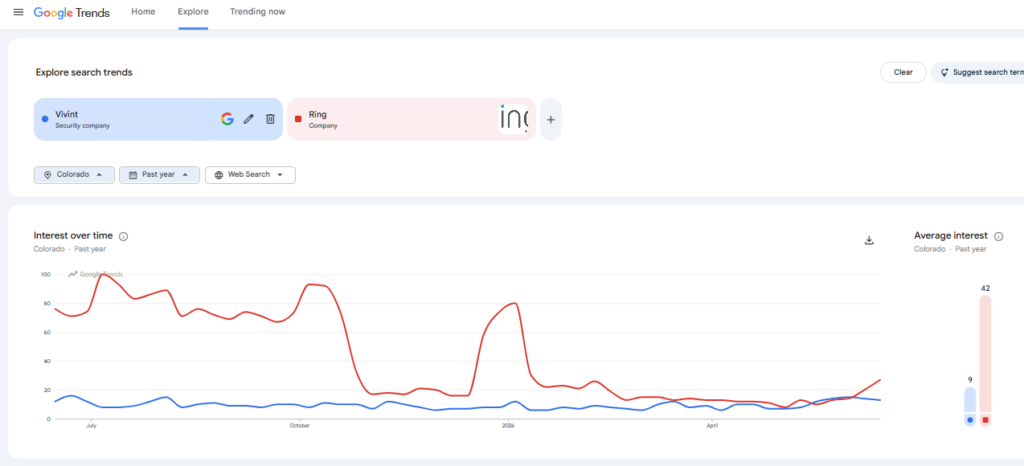
Based on the Google Trends screenshot, Ring dominates search interest in Colorado with an average score of 70-80 compared to Vivint’s 20-30 — a clear 3:1 ratio. This confirms Ring’s position as Colorado’s mass-market default choice.
Seasonal patterns are visible: Both systems see search peaks in July and October, driven by summer moving season and fall preparations for winter. New homeowners and those bracing for Colorado’s harsh winter drive these surges.
Ring users in Colorado are actively researching:
- “ring camera hacked may 28” (+20% increase) — a major privacy concern
- “does amazon own ring” (+10%) — researching corporate ownership
- “ring app down,” “ring camera battery replacement” — practical product issues
- “ring membership,” “ring central login” — account management
Vivint users search the brand name itself, indicating higher brand awareness among those considering professional installation. Vivint searchers are likely further along in the buying journey.
Google Trends Data Breakdown
| Search Metric | Ring | Vivint |
|---|---|---|
| Average Search Interest | High (70-80) | Low (20-30) |
| Search Dominance | Clear leader | Niche interest |
| Peak Months | July, October | July, October |
| Top Rising Query | “ring camera hacked may 28” (+20%) | Brand name searches |
| Key Consumer Concern | Privacy, hacking, Amazon ownership | Service quality |
| Search Behavior | Product-specific, issue-focused | Brand-focused |
What This Tells Us About Colorado Consumers
Ring users are price-sensitive, privacy-worried, and actively researching product issues before buying. The high interest in “ring camera hacked” suggests Colorado consumers are genuinely concerned about cybersecurity — a valid worry given the state’s tech-savvy population in the Front Range.
Vivint users are already aware of the brand and are likely comparing it to other professional systems. They’re less concerned about ownership (fewer queries about corporate structure) and more focused on whether Vivint delivers the premium experience it promises.
Bottom Line: Ring is Colorado’s most searched system, but the queries reveal significant privacy and security concerns. Vivint’s smaller search volume comes from more qualified, already-brand-aware buyers.
Warranty vs. Homeowners Insurance: Know Your Coverage
| Factor | Vivint | Ring |
|---|---|---|
| Manufacturer Warranty | 1-2 yrs, defects only | 1 yr, defects only |
| Weather Damage | ❌ Not covered | ❌ Not covered |
| Hail / Flood / Cold | File homeowners claim | File homeowners claim |
| Insurance Discount | 2-15% with monitoring cert | 2-10% with Ring Protect Pro |
| How to Claim | Contact Vivint support | Contact Ring support |
Climate Impact: Battery vs. Wired in Colorado
Colorado winters routinely drop below 32°F — Ring batteries stop charging at this temperature. Even “wired” Ring devices still run on internal batteries and can fail in deep freezes.
| Device Type | Recommendation | Why |
|---|---|---|
| Ring Battery | ⭐⭐ Avoid | Won’t charge below 32°F. Dies in winter. |
| Ring Wired | ⭐⭐⭐⭐ Best | More reliable. Still may fail in extended cold. |
| Ring Solar | ⭐ Terrible | Snow covers, hail damages, short winter days. |
| Vivint Outdoor Cam | ⭐⭐⭐⭐ Good | Professional install, more robust hardware. |
| Vivint Smart Hub | ⭐⭐⭐ Caution | Must be indoors (32°F-120°F). |
Vivint vs. Ring in Colorado: Which Is More Popular?
Homes in Colorado range from downtown Denver condos and Boulder rentals to sprawling suburban houses and mountain cabins. This diversity directly influences which security system residents choose.
- Ring dominates in apartments and rentals: High-density areas mean residents often can’t make permanent modifications or may move frequently. Ring’s wireless, removable design is perfect. Its low upfront cost and month-to-month subscriptions fit renter budgets. A Ring doorbell and a few indoor cameras provide basic security for a few hundred dollars — and you can take it all with you.
- Vivint dominates in single-family homes and homeowner communities: In suburbs like Douglas County and Arapahoe County, homeowners invest in permanent, integrated upgrades. Vivint’s professional installation ensures aesthetics and optimal performance. Its whole-home automation (locks, lights, thermostats, garage doors) delivers the true “smart home” experience that long-term homeowners value.
So, who wins in Colorado?
- 🏆 Winner: Ring — by sheer market share, brand recognition, and affordability. If you’re a renter, first-time buyer on a budget, or DIY enthusiast, Ring is the clear choice.
- 🥈 Strong Challenger: Vivint — dominates the premium and “set-it-and-forget-it” segments. If you own your home, want the most advanced integrated system, and are willing to pay for professional installation and a long-term contract, Vivint is the superior choice.
What Reviews Say — What Drives Buying Decisions
What Drives People to Vivint
- “It just works”: Hardware quality is high, the system is stable, and smart-home integration is unmatched.
- “Install and forget”: Professionals do everything — no DIY headaches.
- “One app, one panel”: All devices (locks, lights, thermostat, cameras) controlled from a single interface.
What Pushes People Away from Vivint
- “Customer service nightmare”: Complaints about long hold times, unhelpful reps, and broken promises.
- “Contract trap”: Customers feel locked into 3-5 year contracts with expensive early termination fees.
- “High-pressure sales”: Door-to-door reps accused of misleading tactics.
What Drives People to Ring
- “Best bang for your buck”: Excellent basic features at a fraction of the cost.
- “So easy”: Installation and setup are straightforward; the app is user-friendly.
- “No contract freedom”: Cancel anytime with no penalty.
What Pushes People Away from Ring
- “Wi-Fi dependent”: Without Wi-Fi, devices are useless (except Alarm Pro with cellular backup).
- “Colorado winter killer”: Batteries fail in cold weather.
- “Privacy concerns”: As an Amazon company, some users worry about data privacy.
Quick Decision Table: Which System for Your Colorado Home?
| Your Situation | Choose Vivint | Choose Ring |
|---|---|---|
| You own your home | ✅ Best for permanent installations | ⚠️ Works, but less integrated |
| You rent or may move soon | ❌ Long contract, hard to move | ✅ Portable, cancel anytime |
| You want professional installation | ✅ Included | ❌ DIY only |
| You’re on a tight budget | ❌ High upfront cost | ✅ Low cost, pay as you go |
| You want whole-home automation | ✅ Locks, lights, thermostat, garage | ⚠️ Limited to Ring-compatible devices |
| You live in a mountain town | ✅ More robust hardware | ⚠️ Battery issues in extreme cold |
| You have unreliable internet | ⚠️ No cellular backup | ✅ Ring Alarm Pro has AT&T backup |
| You want the best cameras | ✅ 4K, professional placement | ⚠️ Good, but consumer-grade |
| You hate contracts | ❌ 3-5 year commitment | ✅ Month-to-month |
Frequently Asked Questions (Colorado-Specific)
Do I need an alarm permit for my Ring or Vivint system in Colorado?
Yes, in most cities. Denver requires a permit for any burglar alarm monitored by a licensed company. Colorado Springs requires a permit and recently increased fees (2026). Summit County requires separate permits for fire and burglary alarms. You are responsible for knowing your local requirements. Without a valid permit, police may refuse to respond to your alarm.
What are the false alarm fines in Colorado?
Fines vary by city. In Denver, each false panic/hold-up alarm costs $50**. In **Colorado Springs (2026)** : 1st = **$50, 2nd = $100**, 3rd = **$150. In Summit County: 2nd = $75**, 3rd = **$150, 4th+ = $300 each. Fines are issued to the property owner.
Should I buy battery-powered or wired Ring devices in Colorado?
Strongly recommend wired. Colorado winters frequently drop below 32°F (0°C), at which point Ring batteries may not charge at all. Even “wired” devices have issues because they still run on internal batteries. But wired is significantly more reliable than battery-only.
Can I get a homeowners insurance discount with Ring or Vivint?
Yes, but only with professional monitoring. Insurance companies offer 2% to 15% discounts for systems with 24/7 professional monitoring. A Ring doorbell or camera alone does not qualify. You need Ring Protect Pro (for Ring) or Vivint’s professional monitoring plan — and you must submit the monitoring certificate to your insurer. The discount is not automatic.
Does Ring’s cellular backup work in the Colorado mountains?
It depends on AT&T coverage. Ring Alarm Pro uses an AT&T SIM card for cellular backup. While AT&T covers about 97% of Colorado Springs and other urban areas, coverage in mountain communities and rural areas is spotty. Check AT&T coverage at your specific address before relying on this feature. In a power outage, the cellular backup keeps the alarm system (sensors, siren) online — but cameras still need Wi-Fi to stream video.