
Connecticut residents face a unique security landscape—low violent crime rates but persistent property crime anxiety. Over half of Nutmeggers are “highly concerned” about property crime, making the choice between professional and DIY security critical. The difference between Vivint and Ring in Connecticut comes down to lifestyle: Vivint is the premium, professionally installed solution with mandatory installation and high upfront costs, ideal for permanent homeowners in suburban towns like West Hartford or Stamford who want whole-home automation and active perimeter deterrence. Ring is the DIY, Amazon-owned alternative built on affordability and flexibility—no contracts, easy damage-free installation with adhesive tape, perfect for renters in high-density urban areas like Bridgeport and Hartford who value portability and low upfront costs.
Vivint Connecticut
Professional installation and advanced monitoring tailored for Connecticut homeowners.
📞 Call Vivint Connecticut+1 888 784 0392
Ring on Amazon
Affordable DIY smart security — quick to order and easy to set up for Connecticut renters.
🛒 Shop Ring SystemsNationally, Ring dominates in sales volume as the mass-market leader, while Vivint holds a premium niche. Vivint’s equipment costs start at $599.99+ with $39.99/month monitoring, while Ring’s base kit starts at $244.95 with $4.99–$20/month monitoring—a massive $1,000–$2,800 price difference over three years. Connecticut’s strict false alarm laws (3 free false alarms per year before $25–$100 fines) and harsh winters make this decision even more nuanced.
2026 Alert: Stonington requires annual alarm registration at $10 per alarm, with 3 free false alarms before fines start at $25 . If you don’t add your permit to the Ring app, emergency responders may not be dispatched .
Core Comparison: Key Factors for Connecticut Buyers
Google Trends: What Connecticut Homeowners Search Before Buying a Security System
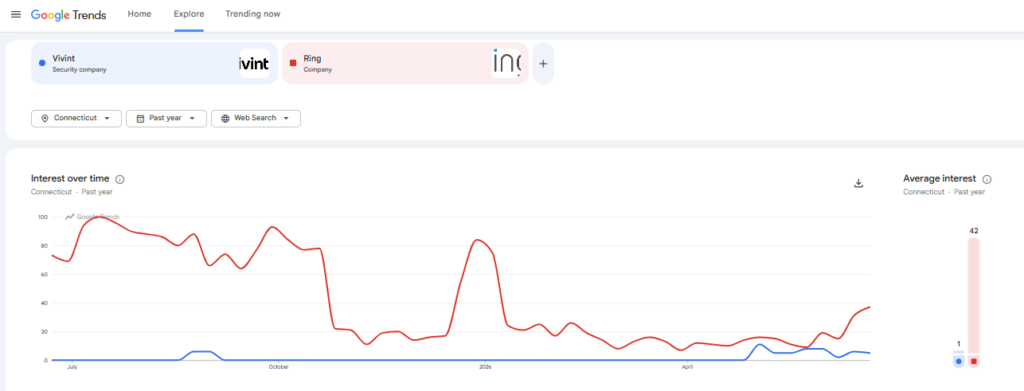
Based on the Google Trends screenshot, Ring dominates search interest in Connecticut with an average interest score of 42 compared to Vivint’s 1. The data shows Connecticut consumers searching for Ring are highly specific: “ring doorbell camera” saw a 40% increase, “ring camera doorbell” rose 30%, and “ring doorbell” increased 10%. Interestingly, “ring subscription” dropped 10%, suggesting consumers may be hesitant about ongoing costs.
The rising queries reveal key concerns: “ring camera hacked may 28,” “is ring down,” “ring app down,” and “ring outage” all appear—indicating Connecticut consumers are actively worried about service reliability and security vulnerabilities. This aligns with the fact that Ring devices are heavily Wi-Fi dependent, and Connecticut’s harsh winters can disrupt both power and internet.
For Vivint, “vivint home security” saw a 60% increase, and “vivint reviews” appeared as a breakout query. This suggests Connecticut consumers researching Vivint are further along in their buying journey, actively seeking reputation information before committing to a long-term contract.
| Search Metric | Ring | Vivint |
|---|---|---|
| Average Search Interest | 42 (High) | 1 (Low) |
| Top Rising Query | ring camera doorbell (+40%) | vivint home security (+60%) |
| Key Consumer Concern | Service outages, hacking, app reliability | Reviews, customer service |
| Search Behavior | Product-specific, issue-focused | Reputation-focused, comparison-oriented |
Warranty vs. Homeowners Insurance: Know Your Coverage
| Factor | Vivint | Ring |
|---|---|---|
| Manufacturer Warranty | 1-2 years, defects only | 1 year, defects only |
| Weather Damage | Not covered | Not covered |
| Extreme Cold / Snow / Ice | File homeowners claim | File homeowners claim |
| Insurance Discount | Up to 20% with monitoring cert | Up to 20% with Ring Protect Pro |
| How to Claim | Contact Vivint support | Contact Ring support |
In Connecticut, homeowners insurance is your primary protection against weather-related equipment damage. Neither Vivint nor Ring covers extreme cold damage, snow accumulation, or ice storm damage under their standard warranties. Adding freeze sensors and water leak sensors can maximize your insurance discount—especially valuable in Connecticut winters where frozen and burst pipes are a serious threat .
Regional Climate Impact: Battery vs. Wired in Connecticut
Connecticut’s climate presents significant challenges for battery-powered security devices. Winter temperatures frequently drop below 0°F (-18°C), and University of Connecticut researchers project a 5°F increase in annual mean temperature by mid-century with more extreme weather events .
Ring devices operate optimally at approximately 77°F (25°C) and can function between -4°F and 122°F (-20°C to 50°C). However, at 36°F (3°C), the battery may not hold a charge effectively. At 32°F (0°C), the battery may not charge at all—even hardwired configurations may not charge the battery. At -5°F (-20.5°C), the battery may disconnect power completely until temperatures warm up. Ring battery-powered devices are run off the batteries, not off of the external power source. When the temperature drops below freezing, the battery will stop accepting the external charge and may run out of power.
| Device Type | Connecticut Recommendation | Why |
|---|---|---|
| Ring Battery | Avoid | Won’t charge below 32°F. May stop working entirely in deep cold. |
| Ring Wired | Best | More reliable. Still may struggle in extreme conditions but significantly better. |
| Ring Solar | Not recommended | Snow covers panels, short winter days, overcast conditions. |
| Vivint Outdoor Cam | Good | Professional install, more robust hardware. |
| Vivint Smart Hub | Caution | Must be kept indoors (32°F-120°F). Never in garages or attics. |
Internet Reliability and Cellular Backup Coverage in Connecticut
Ring Alarm Base Station includes a pre-installed AT&T SIM card for cellular backup. AT&T has invested nearly $500 million in Connecticut network infrastructure from 2020-2024, including $200M in the Hartford area, $110M in Bridgeport-Stamford, and $110M in New Haven. AT&T’s 4G network covers 84% of Connecticut, and 5G spans 55% of the state.
However, during winter storms when power outages occur, Wi-Fi routers go down and cameras lose connectivity. Cellular backup keeps the alarm system online—but cameras still need Wi-Fi to stream video. AT&T’s recent expansion includes 13 new sites in communities including Bridgeport, Meriden, Milford, Old Saybrook, Goshen, Greenwich, Durham, New Hartford, Darien, Stamford, and Woodstock.
Is Ring or Vivint More Popular Among Connecticut Homeowners?
Connecticut homes range from Hartford apartments and Bridgeport condos to suburban houses in West Hartford and Stamford. Ring dominates in apartments and rentals—wireless, removable, low cost, month-to-month. Vivint dominates in single-family homes and homeowner communities—professional installation, permanent integration, whole-home automation.
Who wins in Connecticut? Ring wins by sheer market share, brand recognition, and affordability. If you are a renter, first-time buyer on a budget, or DIY enthusiast, Ring is the clear choice. Vivint remains the superior choice for homeowners who want the most advanced integrated system and are willing to pay for professional installation and a long-term contract.
What Reviews Say — What Drives Buying Decisions
What Drives People to Vivint:
- Hardware quality is high, the system is stable, and smart-home integration is unmatched
- Professionals do everything—no DIY headaches
- All devices controlled from a single interface
What Pushes People Away from Vivint:
- Contract termination barriers: one Middletown, CT reviewer reported being forced to provide a 30-day written notice via certified mail, and after the window passed, the company still refused to release their paid-for equipment
- Complaints about contracts not being clearly explained
- Historical AG actions in multiple states over deceptive sales practices
What Drives People to Ring:
- Excellent basic features at a fraction of the cost
- Installation and setup are straightforward; the app is user-friendly
- Cancel anytime with no penalty
What Pushes People Away from Ring:
- Without Wi-Fi, devices are useless (except Alarm Pro with cellular backup)
- Batteries fail in cold weather—a major concern in Connecticut
- As an Amazon company, some users worry about data privacy
Quick Decision Table Vivin Vs Ring
| Your Situation | Choose Vivint | Choose Ring |
|---|---|---|
| You own your home | Best for permanent installations | Works, but less integrated |
| You rent or may move | Long contract, hard to move | Portable, cancel anytime |
| You want professional installation | Included | DIY only |
| You are on a budget | High upfront cost | Low cost, pay as you go |
| You want whole-home automation | Locks, lights, thermostat, garage | Limited to Ring-compatible devices |
| You live in coastal CT | More robust hardware | Hardwired needed for salt air |
| You hate contracts | 3-5 year commitment | Month-to-month |
Connecticut-Specific Questions About Vivint Vs Ring
Do I need an alarm permit for my Ring or Vivint system in Connecticut?
In some towns, yes. Stonington requires annual registration at $10 per alarm, with forms mailed in December for the following calendar year . Connecticut state law gives you 3 free false alarms per year before fines start at $25 . You must add your permit to the Ring app—otherwise, emergency responders may not be dispatched .
What are the false alarm fines in Connecticut?
For state police dispatch: 1st-3rd false alarms are free; 4th costs $25; 5th costs $50; 6th costs $75; 7th+ costs $100 each. Stonington: 1st-3rd free; 4th-6th $25 each; 7th-10th $50 each; 11th+ $100 each . False alarms caused by acts of nature (including storms) are exempt from fines.
Should I buy battery-powered or wired Ring devices in Connecticut?
Strongly recommend wired. Connecticut winters routinely drop below 32°F, at which point Ring batteries may not charge at all. At -5°F, the battery may disconnect completely until temperatures warm up. Wired devices are significantly more reliable—though even they may struggle in extreme conditions.
Can I get a homeowners insurance discount with Ring or Vivint in Connecticut?
Yes, but only with professional monitoring. Insurance companies offer up to 20% discounts for systems with 24/7 professional monitoring. A Ring doorbell or camera alone does not qualify. Add freeze sensors and water leak sensors to maximize your discount—especially valuable in Connecticut winters.
Does Ring’s cellular backup work in Connecticut?
It depends on AT&T coverage. Ring Alarm Pro uses an AT&T SIM card. AT&T’s 4G network covers 84% of Connecticut, with $500 million invested in network infrastructure. However, coverage gaps exist in some rural areas. In a power outage, cellular backup keeps the alarm system online—but cameras still need Wi-Fi to stream video.